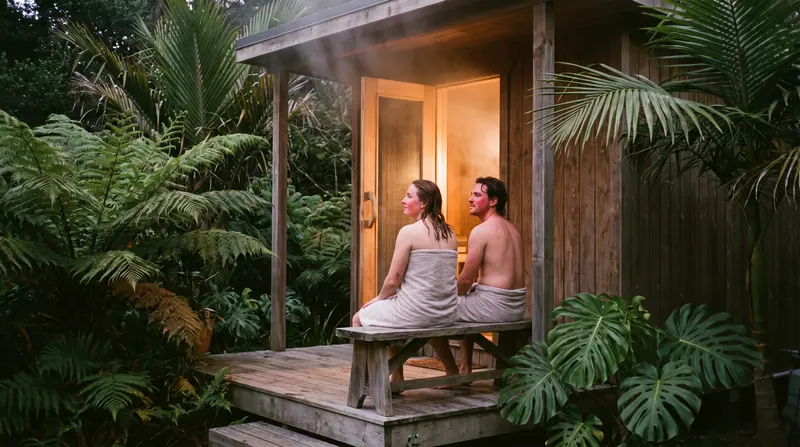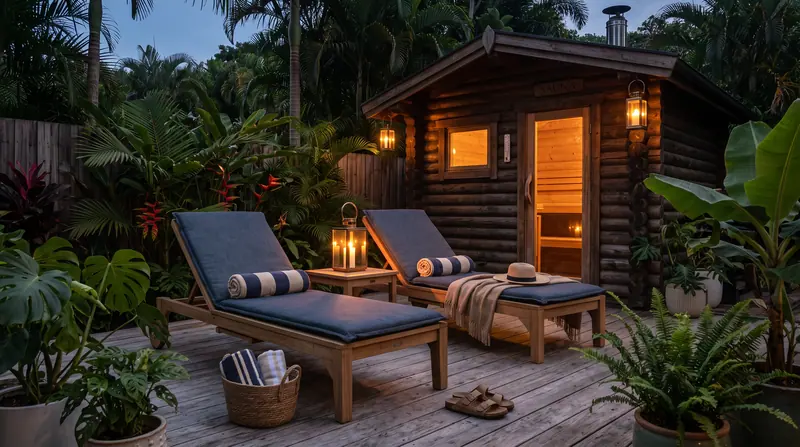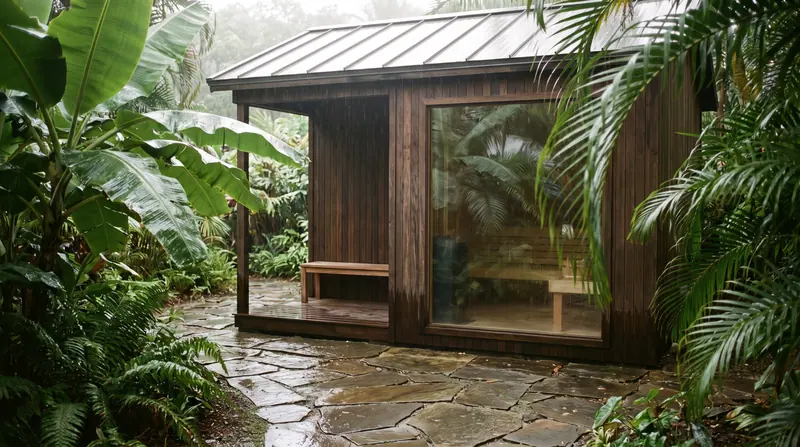
The requests for outdoor builds almost always begin with a photo. Someone sends us a picture of a timber sauna cabin in a Finnish forest or a Japanese garden and asks: “Can this stand in my yard in Medan Johor?” The answer is yes — we build them — but the honest version of the answer is longer, because that Finnish cabin was designed for snow, and yours has to live with equatorial sun, months of rain and 80 percent humidity.
An outdoor sauna in Indonesia leads a harder life than any indoor build. Rain falls most of the year, peaking between September and December. UV strong enough to fade car paint works on the timber every day. Warm, wet air pushes mold into any corner that cannot dry. None of that is a reason to skip the idea — it is a reason to build it properly, and the difference between a garden centrepiece and a sad grey shed a few years later is a short list of non-negotiables we refuse to skip.
Here is how we build outdoor saunas from our base in Medan: the formats, the tropical rules, the electrics that have to cross your garden safely, and real indicative prices.
Classic outdoor cabin or custom garden cabin
The classic outdoor sauna cabin is the format that made garden saunas famous, and it earns the fame. The rectangular cabin encloses a compact volume that heats quickly and evenly to the classic 70–90°C at 10–20 percent humidity; the timber silhouette under its pitched protective roof turns a garden corner into a destination. We assemble these cabins in 1–2 weeks on site, line the interior in western red cedar, Scandinavian spruce or thermowood, build benches in aspen or abachi that never scorch bare skin, and fit imported Harvia, Sawo or Tylo heaters with 1–2 year factory warranties.
The custom garden cabin is the roomier alternative: a small timber building with room for a proper changing area, a bench for cooling down under the eaves, sometimes an outdoor shower beside it. It takes more time and more foundation work than the compact classic cabin, but it can be shaped around exactly how your family will use it.
Both formats sit in the same indicative band of IDR 80–150 juta turnkey. If you are still weighing indoors against outdoors, our home sauna builds cover the indoor path — and for villas or venues that want an outdoor sauna as a guest feature, our commercial sauna work handles the heavier duty cycles.
What an outdoor sauna in Indonesia must survive
Rain. A roof or canopy over the sauna is mandatory in our builds — not an upgrade, not an option. It takes the daily beating from downpours so the sauna body does not have to, and it keeps the entrance dry so the sauna does not drink water every time the door opens in a storm.
Sun. Equatorial UV greys and cracks unprotected timber faster than most owners expect. The canopy does most of the shielding; surface treatment of exposed faces does the rest.
Ground moisture. The sauna stands on a raised, drained base, never on soil or on a slab that ponds. Splashback and standing water are how rot starts at the bottom of any garden structure here.
The tropics inside the walls. The same rules as our indoor builds, applied with even less forgiveness: aluminium-foil vapour barrier, an air gap behind the interior lining, paired intake and exhaust vents so the hot room dries out after every session. This is the difference between a sauna and a slowly composting cylinder.
And one material rule that surprises people: Sumatra’s dense hardwoods — ulin, bengkirai — are superb for the outdoor decking and steps around the sauna, but wrong inside it, where their density makes surfaces too hot to sit on. Imported softwoods inside, local hardwoods underfoot outside. Each wood where it belongs.
Choosing the spot for a garden sauna
During the free survey we walk the garden with you and look for four things. Distance from the house, because every metre adds cable and plumbing run. Roof runoff and drainage, because the perfect-looking corner is sometimes where the whole garden drains. Access, because a cabin’s parts and a crew need to reach the spot without dismantling your fence. And the view, because a garden sauna is half about what you see from the bench — in Medan Johor that might be your own trees; on a Berastagi hillside it might be the Karo highlands.
Getting power safely across the yard
The heater draws 6–9 kW, and this is where many outdoor dreams meet the electrical panel. Older Medan homes often run on 2,200–5,500 VA; the sauna typically needs a PLN upgrade to 7,700–11,000 VA, billed at PLN tariffs, and we prepare the paperwork with you. From the panel we run heat-resistant SiHF cable on a dedicated breaker with an ELCB, routed and protected so that garden work and standing water can never reach it. If an upgrade is impossible at your address, we will say so at the survey — an infrared cabin indoors on 1.7–2.4 kW is often the honest fallback.
What an outdoor sauna costs
| Format | Indicative price |
|---|---|
| Outdoor sauna (classic cabin), turnkey | IDR 80–150 juta |
| Custom indoor dry sauna 2×2 m (comparison) | IDR 60–120 juta |
| Mini / prefab sauna, supplied and installed | IDR 15–35 juta |
All figures are indicative — the final RAB follows the free garden survey, itemized so you can see what the base, the canopy, the heater and the electrics each cost. Materials arrive via Belawan port in 1–2 weeks from the Jakarta and Surabaya warehouses. Running costs match an indoor dry sauna: roughly IDR 200–500 thousand per month at 2–3 sessions a week, indicative. A PLN upgrade, where needed, is the owner’s cost at PLN tariffs.
Where garden sauna cabins make the most sense around Medan
Medan Johor is, honestly, the best garden-sauna district in the city: the gated clusters — J City, Citra Wisata, Royal Sumatera — have real gardens, and the green belt makes evenings slightly cooler, which is exactly when outdoor sessions happen. Deli Serdang adds generous plots in Cemara Asri and villa projects along the Kualanamu corridor, where we simply plan the material logistics into the schedule. And Berastagi is the crown: at roughly 1,300 metres, with air of 16–24°C and a hot-springs culture everyone grew up with at Sidebuk-Debuk, an outdoor sauna feels like it was always meant to be there. The 66 km mountain road takes 1.5–2.5 hours, so Berastagi surveys run on a weekly schedule and deliveries are planned tightly. City plots in Polonia and Medan Baru with garden space qualify too — the survey settles it.
Ordering a sauna in Medan, step by step
- Message us on WhatsApp — a few photos of the garden and a rough idea of where the sauna might stand.
- Free survey. We check the spot, drainage, access and your electrical panel; Greater Medan free any day, Berastagi on the weekly schedule.
- 3D design plus RAB — the sauna, the canopy and the base, itemized.
- 50 percent down payment confirms the build and starts the material order — 1–2 weeks to arrive.
- Assembly on site — 1–2 weeks for a classic cabin, longer for a custom build.
- Test firing and handover — we heat it together, walk through care and controls, and hand over a 2-year structural warranty plus the heater’s factory warranty.
Caring for an outdoor sauna in the tropics
The care list is short but real: keep the intake and exhaust vents clear, let the sauna dry after sessions, check the canopy and the base after the September–December rain peak, and treat exposed timber when it starts losing its colour. The heater lives under its factory warranty; the structure under ours. We wrote more about why controlled dry heat works so well in this climate — and what the equator changes about sauna building — in our article on saunas in a tropical climate.
If this sounds like your project — a garden cabin under a canopy in Johor, a sauna on a Berastagi hillside — message us on WhatsApp and we’ll work it out together.