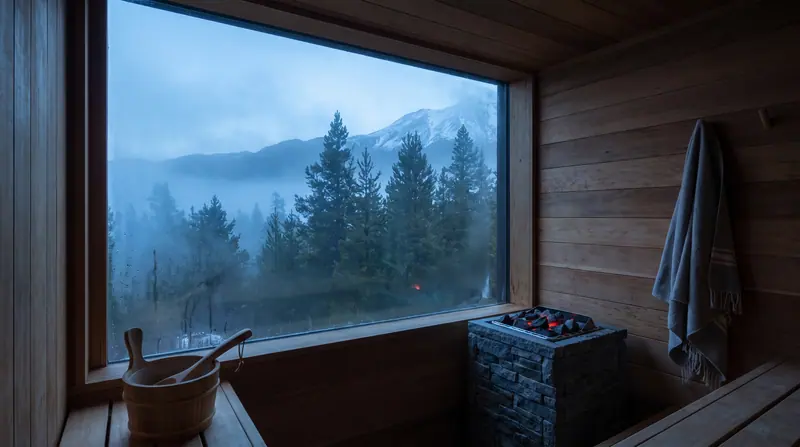
Bayangkan — imagine: it is nine in the evening in the Karo highlands, 18°C and misty, and you walk out of a 85°C cedar hot room into that air with steam rising off your shoulders. Every sauna argument we make in the lowlands — engineering around humidity, timing sessions to air-conditioned evenings — becomes unnecessary here. Berastagi, some 66 kilometres and one winding mountain road from Medan, is the only place in this province where the sauna’s homeland logic works exactly as the Finns intended: real heat, genuinely cool air, repeat.
The town knows it, too, in its bones. Generations of visitors have soaked in the hot springs at Sidebuk-Debuk and Lau Debuk-Debuk on the volcano’s flank; hot-water bathing as recreation needs no introduction anywhere in Karo country. What we bring as builders is the dry-heat version of a pleasure the highlands already understand — and the technical craft to make it last in a place that is cool, damp and two hours from the nearest materials warehouse.
Berastagi projects are a distinct rhythm for us: weekend villas that want a wow factor, small hotels that want a reason for guests to stay a second night, and a survey calendar we run on a weekly schedule. Here is the honest picture.
Why saunas belong in Berastagi
Start with the number that changes everything: 16–24°C. At roughly 1,300 m of altitude, Berastagi’s air is what Medan’s air conditioning spends electricity pretending to be. For sauna use this is not a detail — contrast is the product. The cycle of heating up, stepping out, cooling naturally and going back in is what people fall in love with, and in the lowlands we have to engineer a version of it indoors. Here the town supplies it free, every evening of the year.
The culture is the second half. A sauna lands differently in a place where hot-spring bathing is already a weekend institution: villa guests do not stand at the door asking what it is for, and hotel staff understand the rituals of towels, rinse and rest without a training seminar. Between the springs’ sulphurous soak and a cedar room’s dry 70–90°C heat there is no rivalry — visitors happily do both in one weekend, which is exactly what makes the sauna such a natural amenity for hospitality here.
And the third factor is the property stock: weekend villas built by Medan families as an escape from the lowland heat, plus hotels and guesthouses serving the fruit-market-and-volcano tourist trade. Both types have gardens, views and cool nights — the raw ingredients of a memorable sauna.
What we build as a sauna builder in Berastagi
The highland order book:
- Outdoor and garden saunas. The signature format for the hills: a garden sauna cabin on a villa lawn, assembled in 1–2 weeks, roofed against mountain rain and UV, with hardwood decking underfoot.
- Home saunas for villas. An indoor home sauna in cedar or spruce keeps year-round owners warm through the highland wet season without stepping outside.
- Hotel and guesthouse saunas. A commercial sauna built for daily guest rotation is the amenity that separates a Berastagi hotel from the one next door — 4–8 weeks, from an indicative 150 juta IDR.
- Steam rooms. For spa corners and larger villas, a steam room at 40–45°C and full humidity — fully tanked, tiled and sloped — completes the wellness pairing.
- Renovations. The hills hold older saunas from earlier hotel generations; a sauna renovation at an indicative 15–50 juta often revives them for less than owners fear.
Highland weather is kinder, not harmless
It would be easy to assume the mountain climate solves everything. It solves one thing — the step-out air. The rest still demands tropical-grade discipline. Berastagi is wet and often misty; timber that stays damp rots at 18°C nearly as happily as at 30°C, so outdoor builds keep the full protective specification: a proper roof or canopy over the cabin, ventilated construction that dries the structure between uses, an aluminium-foil vapour barrier behind the interior panelling, and ulin or bengkirai reserved for decking only — never inside the hot room, where dense wood scorches skin.
Electrics get the same rigour as everywhere: a 6–9 kW heater wants 7,700–11,000 VA, which villa connections do not always have. We check capacity at the survey, help with PLN paperwork when an upgrade is the right call — the owner pays PLN’s official tariffs — and wire every cabin with heat-resistant SiHF cable, a dedicated breaker and an ELCB. Heaters are imported Harvia, Sawo or Tylo units with 1–2 year factory warranties, and the cool climate takes nothing away from their duty cycle: commissioning ends with a full test firing, the same as in the city.
The mountain road, planned properly
The honest constraint of Berastagi work is the road: about 66 km from Medan that takes 1.5–2.5 hours through the switchbacks, longer when the fruit trucks are out. We fold that into the project instead of letting it fold us. Surveys run on a weekly schedule — tell us your window on WhatsApp and we slot you into the next mountain day, with photos and a video walk-through exchanged beforehand so the visit is decisive. Materials land at Belawan port within 1–2 weeks, are staged complete in Medan, and go up the hill in consolidated deliveries timed to the installation window. Our installers work Berastagi builds in planned multi-day blocks rather than daily commutes, which keeps timelines standard: 1–2 weeks for a garden cabin, 2–4 weeks for an indoor sauna, 4–8 for commercial fit-outs.
What a sauna costs in Berastagi
The same benchmark table we use across Greater Medan — indicative until the survey:
| Project | Indicative price (IDR) |
|---|---|
| Outdoor sauna (classic cabin) | 80–150 juta |
| Custom home dry sauna 2×2 m (up to 4 people) | 60–120 juta |
| Economy build, combined materials | from 40 juta |
| Mini / prefab sauna, supplied and installed | 15–35 juta |
| Steam room 2×2 m, turnkey | 50–100 juta |
| Commercial sauna (gym / spa / hotel) | from 150 juta |
| Sauna renovation (typical scope) | 15–50 juta |
Mountain transport appears in the RAB as its own line, priced per project rather than smuggled into unit rates. Running costs mirror the lowlands: an indicative 200–500 thousand IDR a month for a dry sauna at 2–3 sessions a week — and highland owners tend to use theirs more, not less.
Berastagi and the lowland map
Most of our Berastagi clients live the two-geography life: a house in the city, a villa in the hills. The route between them runs through Deli Serdang, where we also build for the airport hotel corridor; our base sits in Medan Baru, the old centre where the workshop and materials staging live; and garden-sauna thinking born in Medan Johor translates directly to villa lawns up here — just with better evening air. Briefs that span two properties are welcome; we plan them as one relationship, not two invoices.
Ordering a sauna in Medan, step by step
- Message us on WhatsApp with your villa or hotel location in Berastagi, photos or a video walk-through, and your usual weekend schedule.
- Scheduled free survey. We visit on our weekly Berastagi day, measure, check your electrical capacity and walk the delivery access.
- 3D design + RAB, itemised, with mountain logistics and any PLN upgrade as visible lines.
- 50% down payment starts the material order — 1–2 weeks to Medan via Belawan, then staged delivery up the hill.
- Installation in planned blocks: 1–2 weeks for garden cabins, 2–4 weeks indoors, 4–8 for hotel projects.
- Test firing and handover — with staff instruction for hotels — then a 2-year construction warranty plus the heater’s factory warranty.
Our straight take on Berastagi
We build saunas across Greater Medan and stand behind every one of them, but we will say it plainly: nowhere do they feel as right as here. If you already own a piece of Berastagi — a weekend villa, a guesthouse, a hotel floor that needs a reason to be photographed — the highland air has done half the work of a great sauna already. The other half is ours.
If this sounds like your project — message us on WhatsApp and we’ll work it out together.