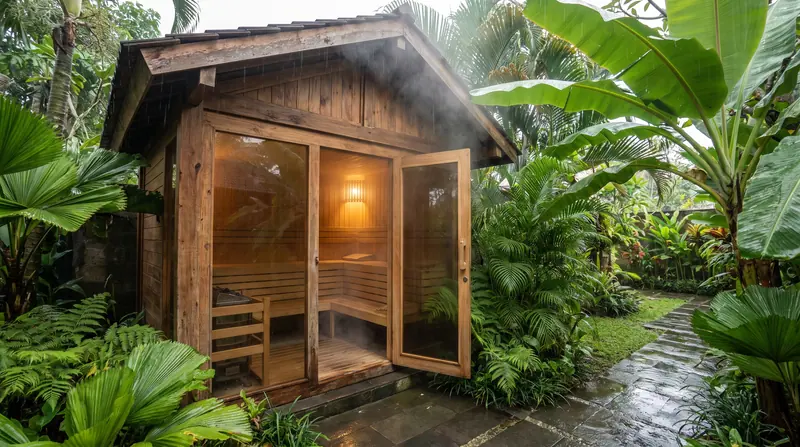
When we tell people in Medan what we do for a living, the reply is nearly always the same joke: “Why would anyone here pay for a sauna? Step outside — it is free.” We have heard it at family gatherings, in hardware stores, and in a good share of the WhatsApp messages we receive. It is a fair question, and it deserves a serious answer — because a sauna in a tropical climate is not just viable. Built correctly, it is arguably more rewarding here than in the cold countries it came from. Built carelessly, the tropics will destroy it within a couple of years.
This article covers both halves: the physiology of why dry heat feels nothing like our humid heat, the engineering that keeps a sauna alive at the equator, and the local geography — including why the mountain town of Berastagi may be the single best place in Indonesia to own one.
Everything here comes from our own builds across Medan, Deli Serdang and the Karo highlands, and every price we mention is indicative until a room has been measured.
Humid heat and dry heat are two different things
Medan runs at 24–33°C with humidity around 80 percent, nearly every day of the year. That heat feels heavy for a precise reason: your body cools itself by evaporating sweat, and at 80 percent humidity evaporation barely works. You sweat, the sweat stays on your skin, and no heat actually leaves your body. That is why an afternoon in traffic feels draining rather than warming — you are wet, hot and getting no relief.
A dry Finnish sauna is the opposite arrangement. The air is far hotter — 70–90°C — but at only 10–20 percent humidity, so sweat evaporates instantly and abundantly. Your circulation lifts the way it does on a brisk walk, muscles let go, and then comes the part tropical weather never offers: the session ends. You step out, take a cool shower, feel your skin tighten and your head clear, and sit down lighter than you stood up. The pleasure of a sauna was never the heat itself; it is the contrast — and contrast is precisely what a uniformly hot, uniformly humid climate cannot give you for free.
The other formats sit on the same spectrum. A steam room runs at 40–45°C and near-100 percent humidity — on paper close to a Medan afternoon, but experienced completely differently: dense, deliberate, eucalyptus-scented, finished in cool ceramic, and over when you decide it is over. An infrared cabin works differently again, holding 45–60°C while its panels warm the body directly rather than heating the air — the gentlest entry point for anyone who finds 90°C intimidating. What all three share is the point: chosen, controlled heat with a beginning and an end, followed by cooling down. Being stuck in weather is not a sauna. Choosing heat is.
What the tropics do to a badly built sauna
Now the engineering half, because the same humidity that makes a sauna feel so good here is also its worst enemy. Every session drives hot, moist air toward the walls; every night, the room swings back to a humid tropical ambient. Without protection, that moisture condenses inside the structure and never fully leaves — and in Medan conditions the result is predictable. In our renovation work, an unprotected sauna shows mold behind the cladding and rot in the frame within 2–3 years.
Three defences are non-negotiable in every sauna we build near sea level:
- An aluminium-foil vapour barrier — actual foil with taped seams, not plastic sheeting — sealing the warm side of the insulation.
- An air gap behind the interior cladding, so the boards dry out after every session instead of sitting against a damp surface.
- Balanced ventilation — a fresh-air intake near the heater and an adjustable exhaust — so the room breathes while you bathe and dries quickly afterwards.
Outdoors, the climate attacks from another direction: rain most of the year with a September–December peak, plus equatorial UV that grays and cracks unprotected timber. Every outdoor sauna we build gets a proper roof or canopy — it is structural protection, not decoration. Wood choice follows the same logic: imported western red cedar, Scandinavian spruce or thermowood for interiors, aspen or abachi for benches, and dense local hardwoods like ulin and bengkirai reserved for outdoor decking, where their toughness is a virtue instead of a burn hazard.
Building a sauna at the equator: what to plan for
Beyond moisture, a sauna in a tropical climate has its own build checklist — the things we verify at every free survey before anyone spends money:
- Electricity before design. A 6–9 kW heater needs a 7700–11000 VA connection, while many older Medan homes sit at 2200–5500 VA. The PLN upgrade is paid at official tariffs and takes time, so it comes first, not last. Where an upgrade is not realistic, an infrared cabin drawing 1.7–2.4 kW solves the problem outright.
- Heat-rated wiring. SiHF cable, a dedicated breaker and an ELCB device — tropical heat and humidity are exactly the conditions where cut-rate wiring fails.
- Real lead times for materials. Heaters from Harvia, Sawo and Tylo and imported timber arrive through Belawan port, typically 1–2 weeks from Jakarta or Surabaya stock. We order at contract signing so the site never waits.
- Timelines that respect the climate. A home dry sauna takes 2–4 weeks of installation; a steam room 3–5 weeks, because waterproofing must cure properly in humid air; an infrared cabin 1–2 days; an outdoor sauna 1–2 weeks of assembly.
- Session habits. In lowland Medan, saunas are at their best in the evening, in an air-conditioned house, when the day’s heat has broken — a small routine detail that makes ownership dramatically more pleasant.
Why Berastagi is sauna heaven
Sixty-six kilometres from Medan — call it 1.5–2.5 hours up the serpentine — Berastagi sits at roughly 1,300 metres in the Karo highlands, and the air runs 16–24°C. That one number changes the entire experience. Step out of a 90-degree sauna into a 17-degree mountain evening and you get the full Nordic contrast — the gasp, the steam rising off your shoulders, the ten-minute afterglow — that lowland Indonesia simply cannot produce.
Culturally, the ground is already prepared. Everyone in the region knows the hot springs of Sidebuk-Debuk and Lau Debuk-Debuk, where soaking in volcanic water on a cool evening is a normal weekend ritual. A sauna at a weekend villa or highland guesthouse is a natural extension of a habit people already love, which is why so much of our outdoor garden sauna work points up the mountain. Hotel and villa owners there increasingly treat a sauna as the amenity that separates their property from the one next door — the same logic that drives our commercial sauna projects for gyms and spas down in the city.
One practical note: because of the distance, we run surveys in Berastagi on a schedule, once a week, rather than on demand — free, like every survey, just booked ahead. Material logistics over the mountain road go into the RAB from the start.
Which sauna works best in a tropical climate
Indoors, the classic dry sauna wins. Inside an air-conditioned home it is the most rewarding format per session, and with foil, gap and ventilation it lives happily at sea level. This is the heart of our home sauna building service, and the format we install most across the city — from renovated colonial-plot houses in Medan Baru to new builds in Medan Polonia, which often come with 7700+ VA already in place.
For compact homes, infrared. Around Medan Selayang, where houses are newer and tighter, an infrared cabin needs only a corner, 1.7–2.4 kW and 1–2 days of installation.
For gardens, a sauna cabin under a roof. The gated clusters of Medan Johor — J City, Citra Wisata, Royal Sumatera — have the yards for it, and evenings there run slightly cooler thanks to the green belt.
For lovers of wet heat, a steam room. Counterintuitive in the tropics, but a properly waterproofed steam room at 40–45°C is a controlled, aromatic ritual that a humid afternoon never is.
Indicative budgets for each, from our standard benchmarks:
| Format | Indicative price |
|---|---|
| Custom home dry sauna, 2×2 m | IDR 60–120 million |
| Mini / prefab sauna, installed | IDR 15–35 million |
| Infrared cabin, 1–2 people | IDR 30–70 million |
| Steam room, 2×2 m, turnkey | IDR 50–100 million |
| Outdoor sauna (classic cabin) | IDR 80–150 million |
| Commercial sauna (gym, spa, hotel) | from IDR 150 million |
Running costs stay modest: at 2–3 sessions a week, roughly IDR 200,000–500,000 per month for a dry sauna, IDR 100,000–250,000 for infrared and IDR 300,000–600,000 for steam — indicative, mostly electricity. The full budget picture, including the hidden costs, is in our guide to what a sauna costs in Indonesia.
So, does a sauna in the tropics make sense?
Yes — a sauna in a tropical climate makes sense, on two conditions. First, it must be built for the climate: aluminium-foil vapour barrier, ventilated air gap, balanced airflow, a roof if it lives outside. Second, the electrical question must be answered before the design is drawn, not after. Meet those two conditions and the tropical argument flips entirely in the sauna’s favour: controlled dry heat followed by a cool shower is the one kind of heat Medan cannot hand you for free, and up in Berastagi the mountain air completes the ritual better than most of Europe.
Skip those conditions, and the climate will quietly take the sauna apart — we have rebuilt enough of them to promise you that. If you are weighing the self-build route, read our honest guide to building your own sauna first; the moisture chapter matters twice as much at sea level.
If this sounds like your project — a cedar room in the city or a garden cabin above the clouds — message us on WhatsApp and we’ll work it out together.