Every month, someone in Medan gives up on the idea of a sauna after one look inside their electrical panel. The house runs on 2,200–5,500 VA, the way many older homes here do; a proper 6–9 kW sauna heater would demand a PLN upgrade to 7,700–11,000 VA, and sometimes that upgrade is impractical, unaffordable or simply not allowed at that address. This is the exact moment we bring up infrared — not as a consolation prize, but as a genuinely different machine that happens to fit the constraint perfectly.
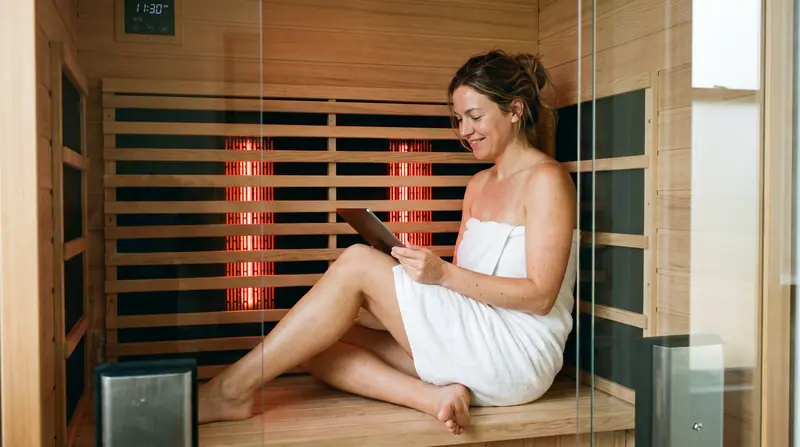
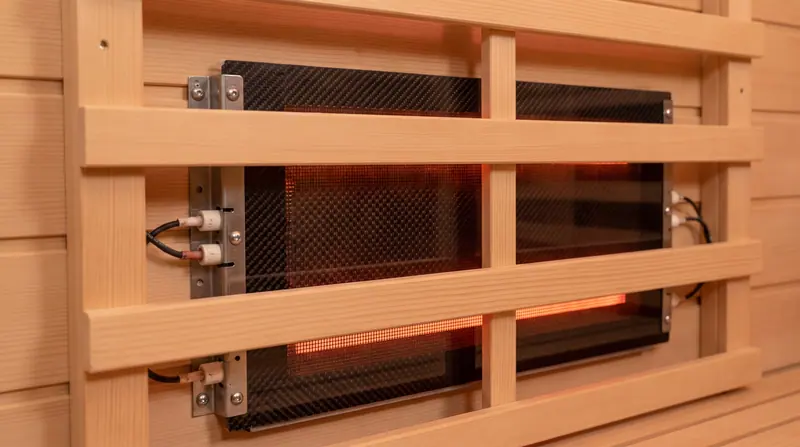
An infrared cabin does not try to heat a roomful of air. Its panels radiate heat that your body absorbs directly, so you sweat generously while the air around you stays at a moderate 45–60°C. The cabin plugs into the kind of power an ordinary Medan house already has, arrives as a prefabricated unit, and goes from delivery to first session in 1–2 days. No construction dust, no waterproofing, no PLN negotiations — which is why the infrared sauna in Medan has quietly become our most frequently installed format in compact newer homes.
This page covers how the technology actually works, why it suits this city so well, what it honestly costs to buy and to run, and how the short installation process goes.
How infrared heat actually works
A traditional dry sauna heats air to 70–90°C at 10–20 percent humidity, and the air then heats you. A steam room surrounds you with 40–45°C fog at near-100 percent humidity. Infrared is the third path: the panels emit radiant heat that passes through the air and warms your body directly. The air temperature stays at 45–60°C — a level your face finds easy — while your body works up the kind of sweat you would expect from a much hotter room.
In practice that changes who enjoys it. Sessions feel gentler and can run longer; people who find a 90°C sauna intimidating often settle into infrared immediately; and the cabin is ready faster after switch-on because there is no large mass of air and stone to heat first. What infrared does not give you is the ritual — the löyly, the hiss of water on stones, the wall of heat at the door. We are straightforward with owners about that difference, because the right choice depends on which experience you are actually buying.
Why an infrared sauna in Medan makes practical sense
Start with the electricity, because in this city that is where every sauna conversation truly begins. An infrared cabin draws 1.7–2.4 kW — a fraction of the 6–9 kW a traditional heater demands. That usually means no PLN upgrade, no waiting on paperwork, no rewiring of a house whose electrical bones date from another era. For the older townhouses of Medan Baru, where upgrading a colonial-era building’s supply can be a project in itself, infrared is often the only sauna that makes sense without renovation-scale work.
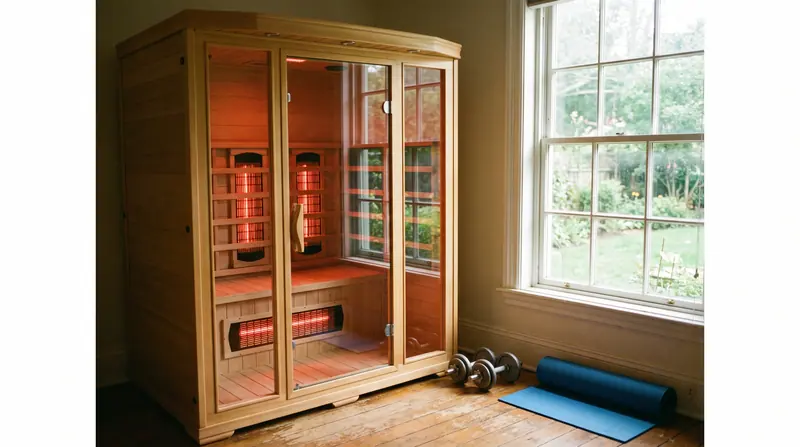
Then the footprint. A 1–2 person cabin occupies about the floor area of a wardrobe, which is why we install so many in the compact newer homes of Medan Selayang — young families near the ring road who want a home gym corner with real recovery. In the bigger houses of Medan Johor and Polonia, the cabin usually lands beside the exercise equipment or in a guest wing.
And the climate. Medan sits at 24–33°C and roughly 80 percent humidity year-round, and the pleasant paradox — controlled dry heat feeling wonderful in a hot country — applies to infrared just as it does to traditional saunas. Most owners run sessions in the evening in an air-conditioned room, where the contrast does the magic. We unpack that physiology in our article on saunas in a tropical climate.
Infrared cabin installation in 1–2 days
Infrared cabin installation in Indonesia is refreshingly free of drama, and we keep it that way with a short, disciplined process. During the free survey we confirm the placement — a dry, ventilated spot with a level floor — and open your electrical panel to verify capacity. The cabin then ships from the Jakarta or Surabaya warehouses, typically 1–2 weeks. On installation day our electrician runs a dedicated circuit with an ELCB (modest power is still power, and we treat every cabin to the same protection discipline as a full sauna), the crew assembles the cabin, and we finish with a test session and a walkthrough of the controls. Day two exists for the cases where the cabin is larger or the circuit run is long. There is no waterproofing, no curing time, no structural work — the entire project fits inside a normal week.
What an infrared sauna costs
| Format | Indicative price |
|---|---|
| Infrared cabin, 1–2 person, supplied and installed | IDR 30–70 juta |
| Mini / prefab dry sauna (comparison) | IDR 15–35 juta |
| Custom dry sauna 2×2 m (comparison) | IDR 60–120 juta |
Figures are indicative; the final quote is confirmed after the free survey, itemized as always. Running costs are where infrared quietly wins: roughly IDR 100–250 thousand per month at 2–3 sessions a week — the cheapest to operate of every format we install, for the simple reason that 1.7–2.4 kW costs less to run than 6–9 kW. For the full budget picture across all sauna types, see our sauna cost guide for Indonesia.
Infrared or traditional: our honest comparison
If your dream involves throwing water on hot stones, feeling the heat shock roll over you and stepping out for a cold shower — infrared will not scratch that itch. Choose a custom home sauna, plan the PLN upgrade, and enjoy the real thing. If what draws you is soft, enveloping warmth at full humidity, that is a steam room — a different build entirely, with waterproofing and tile.
But if the goal is regular, gentle, deeply sweaty heat with zero drama on the electrical panel, minimal footprint and the lowest running cost — infrared wins, and it is not close. It is also the format we recommend to renters, to owners of houses that cannot be rewired, and to anyone who wants a sauna habit rather than a sauna project. There is no wrong answer here, only a wrong match; our job at the survey is to prevent the mismatch.
Where we install infrared cabins
Medan Selayang leads the list — the compact newer complexes near the ring road are full of young families building home gyms, and a 1–2 person cabin fits both the floor plan and the electrical reality. Medan Baru, our home base, comes next: in the district’s older houses, infrared delivers a sauna without touching heritage-era wiring beyond one new circuit. In Medan Johor, cabins usually stand beside the treadmill in the garden-facing room of a cluster home. Polonia’s modern houses take cabins as easily as anything else, and in Deli Serdang we deliver to Cemara Asri and the airport corridor with logistics planned in.
Ordering a sauna in Medan, step by step
- Message us on WhatsApp — tell us who will use the cabin and where you imagine it standing; photos help.
- Free survey. We confirm placement, measure, and check your electrical panel — free across Greater Medan, weekly schedule for Berastagi.
- Cabin selection plus quote. For prefab cabins the design step is light: placement drawing and an itemized quote.
- 50 percent down payment — the cabin ships, arriving in 1–2 weeks.
- Installation in 1–2 days, including the dedicated circuit and ELCB.
- Test session and handover — a 2-year warranty on our installation work, plus the manufacturer’s warranty on the cabin and its emitters.
If this sounds like your project — a quiet cabin next to the home gym, real heat without a PLN saga — message us on WhatsApp and we’ll work it out together.