A few years ago the question came up occasionally; now it closes almost every sauna conversation we have: “Can you add the ice bath too?” We can, and we usually recommend it. We build the wooden plunge tub, install the refrigeration behind it, and connect the two halves — hot cabin, cold water — into one ritual. This page explains the whole machine: construction, temperatures, electricity, prices and upkeep, with the same open numbers we publish for every service.
The starting problem is physics. Water in Medan is never genuinely cold: the city sits at 24–33°C with humidity around 80% all year, and whatever rests in the pipes settles at lukewarm. Bags of ice are the improvised fix, but hauling them in for every session is tedious, adds up in cost and never lands on the same temperature twice. A ½–1 HP chiller ends the problem permanently — it holds the tub at a steady 3–15°C, ready whenever you are, no ice runs, no guesswork.
One thing worth saying before the details: a cold plunge is not a standalone gadget. It is the cold half of a contrast ritual, and it earns its keep next to a hot room. If you do not have that half yet, start with our home sauna construction page and come back here.
What a proper cold plunge actually is
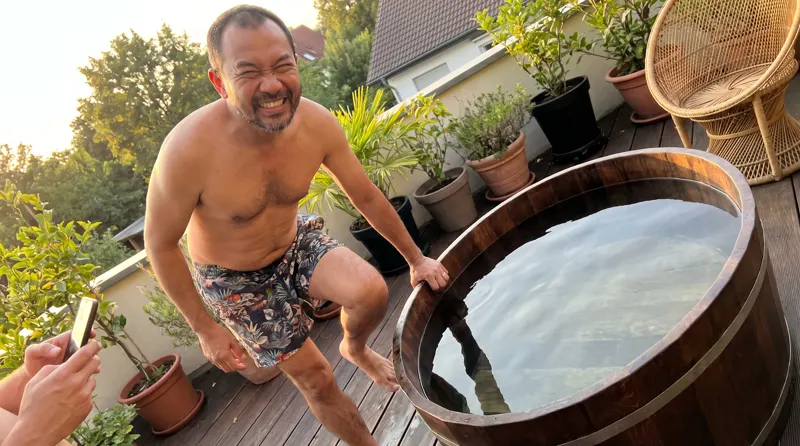
A cold plunge — ice bath, cold tub, pick your term — is a soaking vessel whose water is chilled by a machine rather than by ice. You sit, the water reaches your shoulders, and the temperature stays where you set it because the chiller keeps working in the background.
Plenty of people begin with the improvised version: a plastic drum, tap water, two sacks of ice. As an experiment, fair enough. But the improvised tub fails in three ways the moment the habit becomes serious. The temperature is different every session. The water clouds quickly because nothing filters it. And a plastic drum never sits comfortably beside a sauna you built properly. A permanent tub fixes all three: the chiller owns the temperature, the pump cycles the water through filtration, and the timber body makes the wellness corner look finished rather than improvised.
Why an ice bath in Medan makes perfect sense
It sounds backwards — building a cold pool in a hot city — until you notice that the heat is exactly the point. In the tropics your body almost never meets real cold; for most people in Medan, the coldest thing in a normal week is the air-conditioning vent in the car. Water at 3–15°C is a categorically different experience: the breath catches, the shoulders rise, and a minute or two later a calm arrives that is hard to describe and easy to get attached to.
The effect is strongest for people who train. After weights, futsal or a humid evening run, a cold soak helps the body shed heat and begin recovering — the same logic that has athletes climbing into ice tubs after matches. And since nature will never deliver cold water to this city, a machine is the only way to own the experience at home. The physiology of deliberate heat and cold in a tropical setting is something we unpack in our article on saunas in a tropical climate.
Contrast therapy: 70–90°C, then 3–15°C
Here is the rhythm that convinces our clients to build both halves. The session opens in a dry sauna running at 70–90°C — skin flushed, sweat flowing, muscles loose. Then straight down into water at 3–15°C. The hot body meets the cold water; the heart works, the head clears sharply, and when you climb out the freshness is something no ordinary shower produces. Rest, repeat if you like.
In cold countries, nature supplies the second half — a lake, snow, winter tap water. In Medan’s year-round heat and humidity, the cold half has to be manufactured. The sauna provides the fire, the chiller provides the ice, and the two or three steps between them are a distance we design deliberately. One honest note: extreme temperature swings load the heart and blood vessels. If you have a cardiac condition, unstable blood pressure or are pregnant, talk to your doctor first — we will tell you the same thing at the survey.
How we build the tub: timber, liner, chiller, filtration
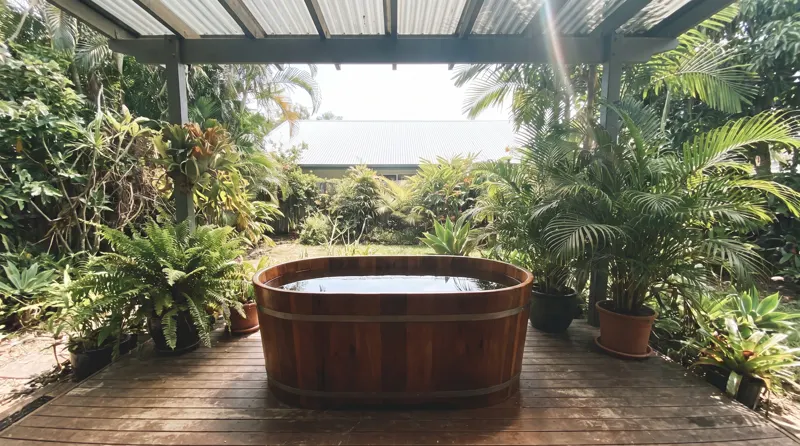
The tub body is larch or thermowood — two timbers that endure constant wet-dry cycling without warping. Inside sits a waterproof liner, so the wood never holds water directly: timber carries the shape and the looks, the liner carries the water. The rim is finished as smoothly as a sauna bench, because anything that touches skin must be kind to it, and a small step makes getting in and out safe.
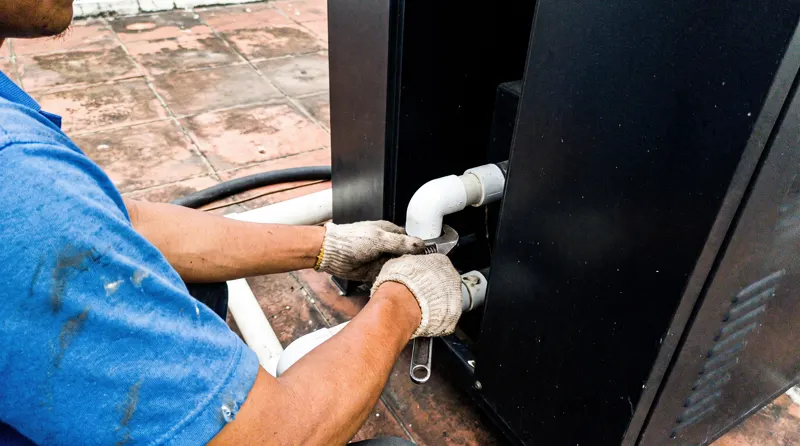
The machinery stands separately beside or behind the tub: the ½–1 HP chiller holding 3–15°C, plumbed together with a circulation pump and filtration. For hygiene we add ozone or UV — both suppress bacteria without giving the water a swimming-pool smell. A fitted cover completes the package, keeping the water clean between sessions and easing the chiller’s workload.
Site preparation is simple but has to be right: a floor drain with a slope for emptying the tub, tidy pipe runs, and ventilation space for the chiller to dump its heat. This is what the survey is for — a badly placed drain or a perfectly flat floor causes years of small annoyances, and both cost almost nothing to fix before the tub exists.
Do you need a PLN power upgrade?
Almost never — and this is usually the biggest relief of the conversation. The chiller draws roughly 0.4–0.75 kW, about one air conditioner, a fraction of what a sauna heater wants. Older Medan homes on 2,200–5,500 VA generally take it without any drama.
Our installation standard stays at full height regardless: a dedicated circuit from the panel, a separate breaker, an ELCB and heat-resistant wiring. A machine that runs daily next to water deserves nothing less. A PLN upgrade only becomes part of the project when the plunge is ordered together with a new dry sauna — it is the 6–9 kW electric heater that demands a 7,700–11,000 VA connection, never the chiller. In that scenario we handle the load calculations and the PLN paperwork as part of the job.
Ice bath and cold plunge prices in Medan
The three packages we build most often — all figures indicative:
| Package | Indicative price |
|---|---|
| Wooden cold plunge + chiller (½–1 HP) | IDR 45–90 juta |
| Chiller only (½–1 HP) | IDR 25–55 juta |
| Wellness zone (sauna + cold pool) | from IDR 250 juta |
Prices are indicative; the final itemized quote follows the free survey. What moves the number inside the range: tub size, timber grade, chiller capacity, and how far the pipes and cabling must run from the panel to the tub.
The chiller-only package suits owners who already have a tub or small pool and need the machinery fitted to it. The wellness zone — sauna, cold pool and rinse area designed as one — is most often requested as part of a commercial sauna project for gyms, spas and hotels, where a hot-cold circuit is now something members actively look for. To compare every service range side by side, see the pricing page.
Where we install them
In Medan Polonia, the plunge is usually born together with a wellness room planned from the first sketch — the modern houses on the old airport land tend to have both the spare power and the spare floor. In Medan Johor, the tub takes its most photogenic position: on the terrace beside an outdoor sauna cabin, under a proper roof. In Medan Baru, our home base, many older houses run on modest connections — exactly where a 0.4–0.75 kW chiller shines, delivering real cold without touching the meter. And for gyms and hotels across Deli Serdang, from Cemara Asri to the Kualanamu corridor, we scale the tub up and tighten the water-care schedule to match member traffic.
Water care without the drama
A permanent cold tub lives or dies by its water, which is why the system does the heavy lifting. Filtration cycles and catches debris; ozone or UV keeps bacteria down; the cover keeps leaves and dust out. Your share is a light routine — rinse the filter, check the water, drain and refill periodically through the floor drain. Minutes, not hours.
Budget IDR 300–700 thousand per month, indicative, covering chiller electricity and water-care supplies. For the wider household math of running hot and cold rooms together, our sauna cost guide lays out every format’s numbers side by side.
Ordering a sauna in Medan, step by step
- Message us on WhatsApp — tell us where the tub would stand and whether a sauna already exists; site photos help. We reply within 1–2 hours, daily 08:00–20:00 WIB.
- Free survey — we check the water point and drain, the floor slope, the electrical panel and the carry-in route, anywhere in Greater Medan.
- Design plus itemized quote — tub size, chiller position, pipe runs and a line-by-line cost breakdown.
- 50% deposit — the tub goes into production and the chiller is ordered; materials arrive within 1–2 weeks.
- The build, 1–2 weeks — floor and drain preparation, tub assembly, the dedicated circuit, and the plumbing between tub and machine.
- Cool-down test and handover — we fill the tub, start the chiller and wait together until the water reaches your target. Two-year warranty on the construction; manufacturer’s warranty on the chiller.
If this sounds like your project — a sauna waiting for its cold partner, or a wellness corner planned from zero — message us on WhatsApp and we’ll work it out together.